







Kate Tolo’s Skin Protocol
Written by Kate Tolo • 07.22.2026
Over the past few years, I've reversed my skin age to 21.
This is based on a scanning device that measures 8 skin markers using multispectral imaging.
I took a scientific approach to reverse my skin age… and you can too. This is a long blog post... I am going to share every treatment and intervention I've done for my skin.
In this blog post:
- how skin measurement works
- my skin protocol
- how to start
- how to track

Before I dive in, it's important to note that facial aging is made up of many different parts.
Aging affects a lot…
- bone structure
- collagen
- hydration
- elasticity
- fat
- placement of tissue (gravity)
This blog post focuses on specific key facial aging markers, and it does not cover them all. So, I am not saying I look 21 years old… or that I am 21 years old according to all skin markers. Just the specific key skin markers that multi-spectral imaging can measure.
And according to those 8 markers, my skin age is 21 years old.

It's also worth noting that 5 years ago, I was eating McDonald's daily and did not do anything specific for my skin…
Then I met Bryan Johnson. We started our scientific health experiment together, and I started to change my core habits, which no doubt had a major impact on my overall aging.
Here's the earliest face scan I can find.
- at age 27, my skin was age 26.
- now age 30, my skin is age 21. (based on multispectral imaging measuring 8 skin markers)
This means that in 3 years, instead of accumulating 3 years of skin age, I reversed my skin age by 5 years.

How does skin measurement work?
This device uses multispectral imaging. It uses standardized visible, polarized, and UV lighting to assess surface and subsurface skin features. It is a well-validated skin-analysis tool.
This measurement does a lot, but not everything.
What it DOES measure:
- spots
- pores
- wrinkles
- texture
- UV spots
- brown spots
- red areas
- porphyrins (bacterial byproducts, which highlight congestion)
It does NOT measure:
- collagen
- elasticity of skin
- structural bone
- plenty else
Currently, there's no easy way to measure things like collagen and bone loss.
My skin protocol
Below is everything I've done for my skin, both present and past:*
- microdose of Accutane
- hyaluronic acid supplement
- vitamin C supplement
- copper supplement
- vitamin D supplement
- other supplements listed below
- avoid sun UV rays
- better sleep
- better nutrition
- better exercise
- BHA (beta hydroxy acid)
- niacinamide
- azelaic acid
- tretinoin
- red light therapy
- microneedling
- IPL (BBL)
- Sculptra
- 1550-nm laser
- Sofwave
- 595-nm pulsed dye laser

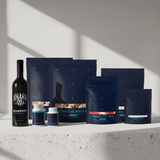
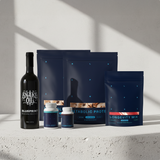
I also use the products below for skin health. They're an important part of my protocol, so it would be weird not to mention them… but they're also from our business. You can get these things from us or somewhere else. I don't mind.
Blueprint supplements and foods:*
- Collagen Peptides
- Extra Virgin Olive Oil
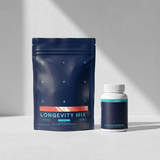
- Longevity Mix
- Omega-3
- Advanced Antioxidants
- Essential Capsules
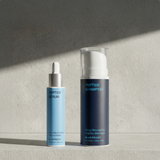
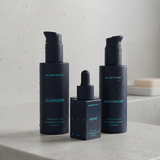
Blueprint skincare:*
I achieved these results without Botox and filler. You can too. Since getting these results, I've dabbled with Botox and filler for facial balancing, which is a whole other art form. I'll share more about those results soon.
How do you start?
Do these 5 things:
- Treat any major conditions
- Add basic interventions
- Get a face scan
- Target specific problems
- Retest

Here's a breakdown of each step…
#1 Treat diseases and conditions**
If you have something major going on, this is the most important step to start with. I use the word "disease" intentionally because people think skin = vanity. But these are medical conditions.
Examples:
- acne
- rosacea
- eczema
- psoriasis
- actinic keratosis
- seborrheic dermatitis
- melasma
In my case, I had been struggling with acne for years. It was a horrible experience, but I didn't take it seriously.

I started microdosing Accutane and my life changed. (I do 40 mg a week under physician supervision.)
Each major condition has a different treatment plan. Chat with an LLM and your doctor, and follow a science-backed treatment path (not random marketing gimmicks).
#2 Basic interventions
Some general things I'd recommend for almost everyone:
- avoid UV damage
- red light therapy
- moisturize and cleanse
- better sleep
- better nutrition
- exercise

And slightly more advanced:*
- collagen peptides (also good for joints)
- hyaluronic acid supplement (found in Longevity Mix)
- vitamin C supplement
- tretinoin
- extra virgin olive oil daily
- skin-bioavailable carotenoid antioxidants (astaxanthin, lutein, and zeaxanthin)
#3 Get a face scan
These aren't consumer devices, but plenty of clinics have them. Search online for "VISIA" to find somewhere local. Important: take a photo of your results for your records.
Each result will include a percentile. The higher the number, the better.
For example: "red areas 55%"
This means you are in the 55th percentile for your age group and skin type. Said another way, you are better than 55% of other people in this marker. This would also mean you're around average, or expected, for your age.

#4 Target specific problems
Now you know where your skin is thriving and where it is struggling.
Here is an example scorecard:
- 98% red areas (good)
- 90% porphyrins (good)
- 88% pores (good)
- 76% texture (good)
- 28% brown spots (bad)
- 19% wrinkles (bad)
- 12% UV spots (bad)
Next, ask your favorite LLM and doctor about scientifically backed treatments for that specific problem. Be clear that you want treatments that are clinically proven. Put together a treatment plan.

Example treatments:
- wrinkles = tretinoin*
- UV damage = protect from sun
- brown spots = hydroquinone
It's important that for each treatment you check what the potential risks are and make sure you're informed by your doctor (ideally a dermatologist).
In almost all cases, protecting your skin from sun damage is a 10/10 treatment option.
Do this:
- sunscreen
- cover your skin when outside (hat, umbrella, face cloth, etc.)
- tint your car windows
#5 Retest
Once you've tried a treatment, go back and rescan your face. Repeat this process, and watch your numbers change.

Skin is just like any other biological organ. You can:
- measure
- diagnose
- treat
- repeat
It annoys me that most of the skincare advice on social media is filled with useless noise.
For women, this is especially important, because obviously beauty is a commodity that is sold to women, and most of the time the things they're selling don't work.
Knowing how to measure your skin is your best protection against this, for everyone.

Final note
I am about to become the female equivalent of Bryan Johnson.
Skin is cool and important, but we're about to spend millions to measure and decode my biology through every phase of the menstrual cycle.
I start in a few days.
Optimizing health for a female means understanding female biology first… the cycle, hormonal transitions, things that have never been properly measured.
In the end, what I want is for women to have agency over their own aging: to be understood, and to make real choices about their bodies with real evidence behind them.
We will share everything we learn, for free. We hope to uncover useful protocols… for your skin and everything else.
_
*Kate’s product recommendations are just one part of her broader health routine. The products alone should not be expected to reduce biological age.
**Diseases and medical conditions should be diagnosed and treated by a medical provider.


